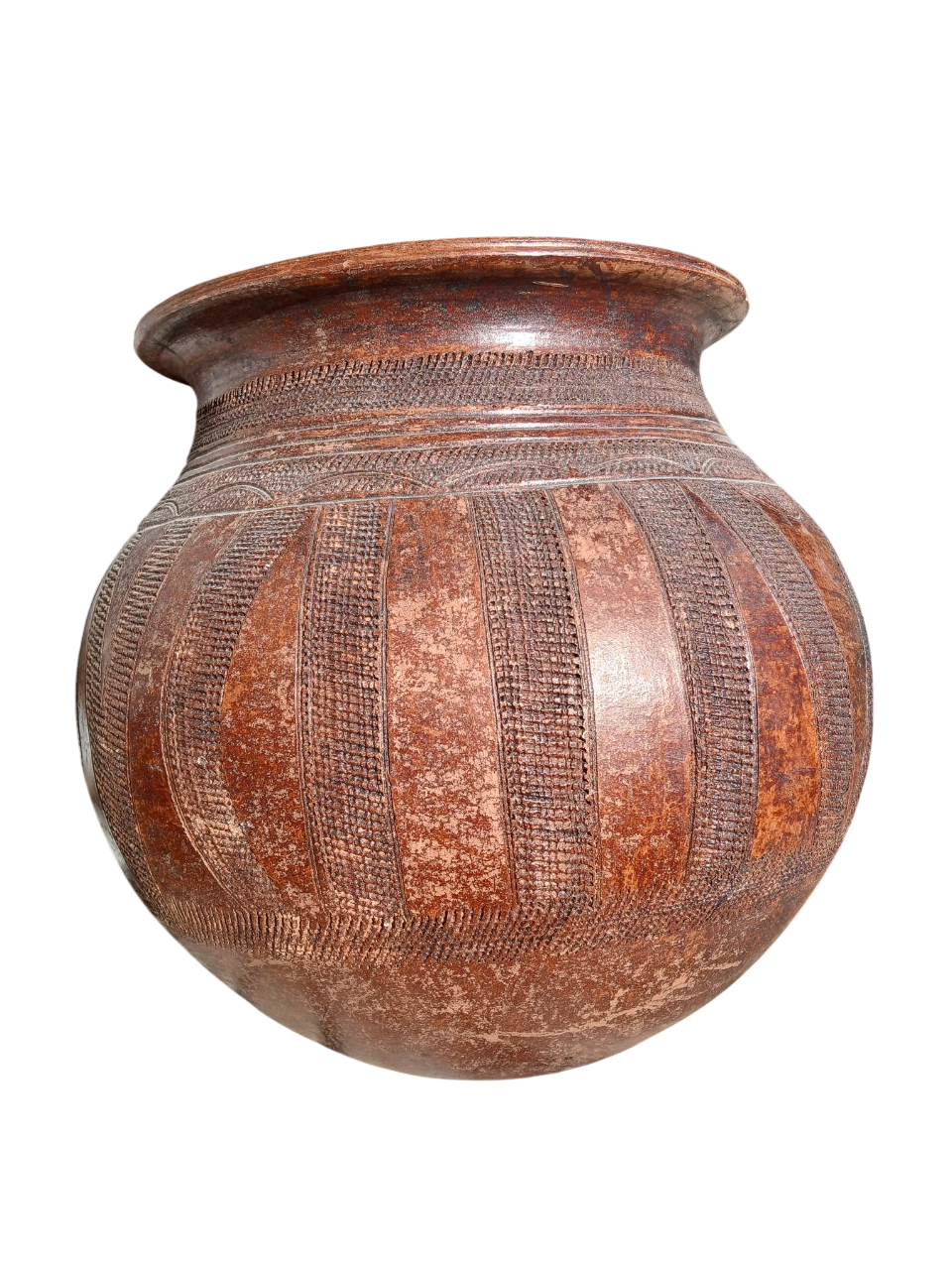
Water storage pot, earthenware with incised and rouletted decoration and locust bean ‘varnish’, Gwari people, Iddo village, Nigeria
Gwari women make pottery in family groups, with daughters learning from their mothers and continuing their craft when they move to their husbands’ compounds. In form and technique Gwari ceramics are related to those of their eastern Nupe neighbors. Potters use the direct pull method, punching down into a lump of clay and then pulling up diagonally with their fingers to form the vessel’s sides, adding coils if a larger size is desired. A potter may use a makeshift turntable to help form a small pot; she will fashion a large one, however, by walking steadily backwards around the piece, dragging one foot to maintain her balance and at times changing direction to avoid dizziness.
Water containers such as this small, classic example are plump-bellied with short, slightly narrowed necks and flared lips. They are decorated with incising and roulette patterns that showcase the sure-handed drawing skills of the maker. Gwari potters incise their wares with a blade that cuts neatly through the coarse clay, producing straight or slightly curved lines that contrast with the roundness of the pot. Here a series of horizontal lines encircles the vessel’s neck in regular intervals, while vertical bands–alternating between straight and elliptical in shape and between smoothly burnished and rough in texture–embellish its body. This container’s dark color results form a solution of locust tree pods that was applied to the red-hot vessel immediately upon its removal from the fire. The coating also helps make the pot watertight.
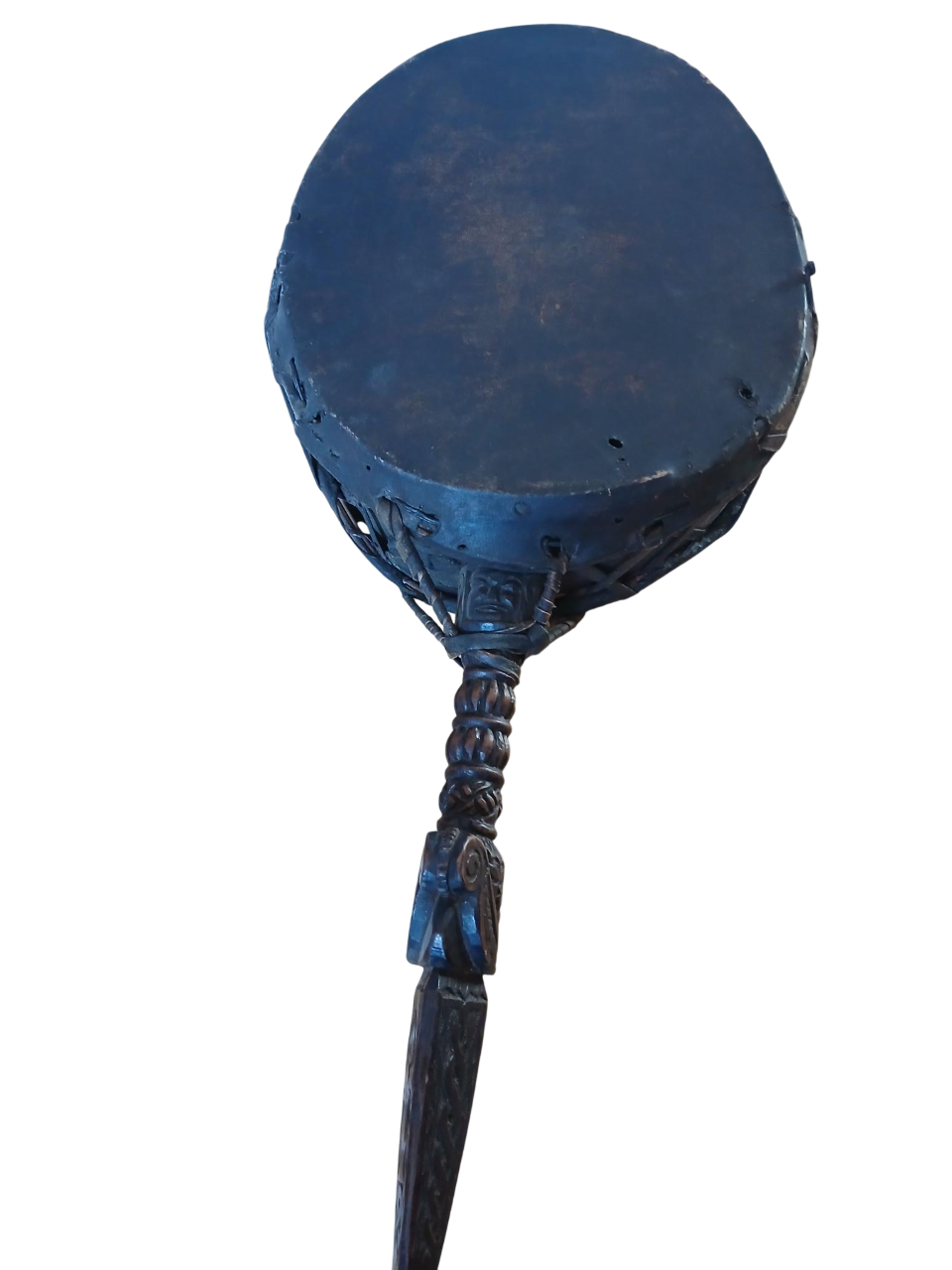
The Dhyāngro, an antique ritual shaman drum, featuring a leather drumhead and a hand-carved wooden handle in a dagger style. Traditionally used by Jhakri (shamans) for rituals to induce trances. The drum is double-headed with a seed rattle inside and dates back to the early 20th century, Nepal
The dhyangro is a frame drum used by jhakri shamans across Nepal, India, and Tibet, particularly among ethnic groups including the Magars, Kirati, Tamang, Gurungs, and Sherpas. This instrument represents one of the oldest shamanic traditions in the Himalayan region, serving as an essential tool for spiritual practitioners who act as intermediaries between the human and spirit worlds.
The drum itself has a distinctive construction. It can be either single or double headed, with the double headed versions said to have male and female sides. The frame is made of wood with animal skin stretched over it, and the drum is equipped with jingles and played with a curved cane. Unlike most frame drums, the dhyāngro includes a handle, which is often elaborately carved with symbolic imagery representing spiritual concepts central to Himalayan belief systems.
The shamans who use these drums, known as jhakri or dhami in various Himalayan regions, represent one of the world’s oldest continuous spiritual traditions. Shamanism in Nepal is deeply tied to animism, the belief that natural elements such as rivers, mountains, trees, and animals possess spirits. These practitioners serve multiple roles within their communities, functioning as healers, spiritual guides, and ritual specialists who maintain balance between humans and the natural world.
 Syder Travel