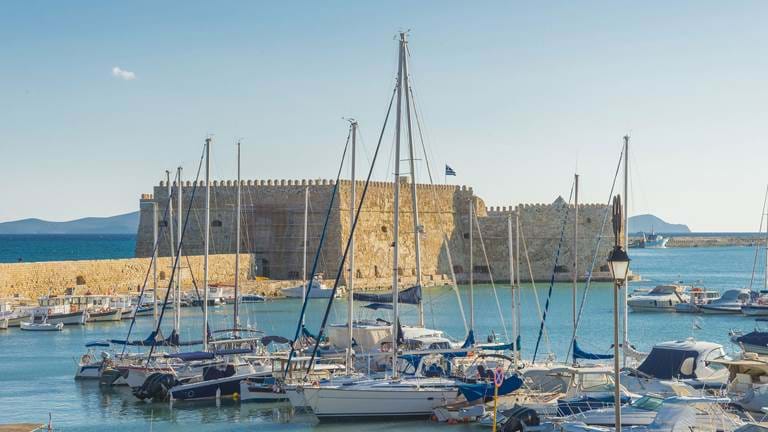
Like all Mediterranean islands, Crete has a rich history defined by the number of different people who invaded it or came to dominate it. Inhabited since the Middle Palaeolithic, it became a dominant power in the Mediterranean in the 3rd millennium BC when the people we referred to as Minoans constructed palaces on a scale not known in Europe at the time, as we will see when we visit the Palaces at Knossos and Phaistos. Although the island never recovered this status after it was dominated by the Mycenaeans, it was prosperous enough to produce the impressive remains seen at Gortyn, which is unique important for the legal code which is preserved in an extant inscription. Much of the charm of the Crete we see today stems from the influence of the more 4 centuries of Venetian rule which saw a flourishing in the island’s architecture and arts as witnessed by the islands more famous artists, El Greco and the writer Kalliakis. This is a tour which has it all: stunning archaeology, romantic cities like Chania and dramatic landscapes accompanied by the island’s wonderful cuisine.
10 – 19 October 2025
Day 1 – Fly to Chania (10th October)
Morning flight with Aegean Airways from Tirana via Athens to Chania arriving in the afternoon. Transfer to the Marrone City hotel for four nights with breakfast daily.
Day 2 – In Chania (11th October)
Today is at leisure in the lovely harbour town of Chania, with its charming Venetian architecture. A perfect opportunity to relax in a harbourside restaurant for lunch and to familiarise oneself with narrow cobbled lanes behind the harbour lined with boutique shops and family run restaurants.
Day 3 – In Chania (12th October)
We start with the newly located Archaeological Museum in nearby Halepa, where we see a plethora of remains dating from the Neolithic to the Roman periods. Highlights of this museum include Minoan ceramics and terracotta figures of bird faced women, as well as a 3rd century mosaic dating from the Roman period. In the afternoon, we will have a walking tour of its pretty Venetian quarter, including the narrow alleys of the Kastelli region and the wider streets of the Jewish district which dates to the 16th century when Jews, exiled from Spain and Southern Italy, made their home here (B)
Day 4 – Kissamos – Phalasarna (13th October)
Today begins at Kissamos Archaeological Museum, housed in a Venetian building called the Dioikitirio, which displays artefacts from the Neolithic period to Late Antiquity. Highlights include stunning mosaics from the Roman period, as well as a Hellenistic tomb. We continue to the ancient city of Polyrhenia; whose acropolis looking out over the Cretan sea is dominated by an imposing Byzantine fortification. We end the day at the Helllenistic town of Phalasarna where see impressive remains of fortifications built to protect the harbour, including 5 towers and a curtain wall (B)
Day 4 – Aptera – Heraklion (14th October)
Leaving Chania, we visit Aptera, whose stunning and strategic positioning ensured it was powerful from the Minoan to the Hellenistic periods. Here we see remains of a 12th century monastery dedicated to St john Theologos, as well as remains of a Classical temple and an impressive Roman cistern. We continue to Heraklion, stopping en route to explore the excellent new Museum of Eleutherna in Rethymnon which displays finds from Eletherna, including an archaic statue, the Lady of Eletherna, reminiscent of the statue of Demeter known as the Lady of Auxerre in the Louvre, and grave goods from the Bronze Age. We transfer to the perfectly located Capsis Astoria hotel for five nights with breakfast daily (B)
Day 5 – Knossos and Vathypetro (15th October)
We visit the Bronze Age palace site of Knossos, one of the pivotal sites of Bronze Age Greece. Excavations here have been overseen by the British School at Athens and the Greek authorities for many years. We continue to the Minoan house at Vathypetro with elaborate shrine and a well[1]preserved wine press. We return to Heraklion and the Heraklion Museum, with its exquisite jewellery and brightly-coloured wallpaintings (B)
Day 6 – Gortyn, Mesara and Ayia Triadha (16th October)
We enjoy a morning at the important Graeco-Roman site of Gortyn. The site is best-known for its collection of 5th century stone blocks, inscribed with the law codes of classical Greece, which provide fascinating insights into property division, adoption, slavery and adultery. We return to the Minoan era at the elegant ‘palace’ at Phaistos, which dominates the fertile plain of the Mesara. Famous finds include the terracotta ‘Phaistos Disc’, stamped with a series of pictographic symbols; and thousands of documents, some inscribed with the earliest known occurrence of the (still undeciphered) writing of the Minoans – Linear A script. We continue to Ayia Triadha, a grand but ruinous Bronze Age villa. Lavish finds include a cache of copper ingots, bronze figurines and three elaborately-carved stone vessels (B)
Day 7 – Gournia and Mochlos (17th October)
We visit the well-preserved Minoan town of Gournia on the northern coast. The remains are clustered around the sides of a hill which is crowned by a ‘palace’. The majority of the houses are on the east slope, built up against each other along paved and stepped streets. Lunch option in a seaside taverna before travelling by fishing boat to the tiny island of Mochlos, once a peninsula, on which stood an important Minoan town. We walk up to the ruins at beautifully situated ruins of Chamaizi, most famous for a Middle Minoan building located on the summit of the hill. (B)
Day 8 – Malia, Sissi and Elounda (18th October)
Today we visit the Palace of Malia, one of the largest Minoan sites, which includes a Late Minoan palace which has a large central courtyard and impressive monumental facades. We continue to the the nearby site of Sissi which has been excavated for the last ten years, revealing settlements from the Early and Middle Minoan periods, including graves which rich finds. The afternoon is free for you to relax in Elounda, where you might to relax or take a boat trip to the evocative island of Spinalonga, site of a former leper colony (B)
Day 9 – Heraklion to London (19th October)
After a leisurely morning with time to enjoy some last minute shopping or perhaps simply stroll through the old quarter of the city and enjoy a final Greek coffee before your transfer to Heraklion International airport for your flight home (B)
Price £1995.00 per person based on sharing a twin/double room
Price includes –
Escorted by specialist Cretan guide
All transportation in Mercedes Veto with driver
Full sightseeing programme including entrance fees
Boutique hotel in Chania (four nights) and a comfortable 4 star hotel (five nights) in Heraklion
All breakfasts included
Airport transfers
Group size (4 passengers)



 Syder Travel