
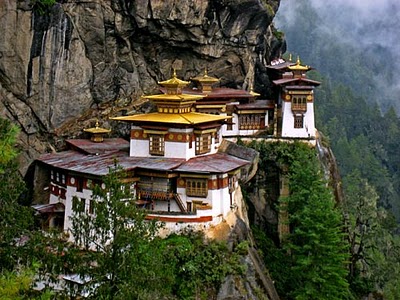
The remote kingdom of Bhutan has a fascinating cultural and architectural heritage plus beautiful mountain scenery. A highlight of any visit to the country is to witness Drubchen (Festival); a colourful event accompanied by Buddhist chants and masked dances. This tour is timed to coincide with one of the least tourist visited festivals and is set in one the most spectacular valleys in Bhutan. The country continues to preserve its cultural integrity and age-old traditions as revealed in this unique and comprehensive tour, which travels through the fascinating western and central regions of the Kingdom of the Thunder Dragon.
13th – 28th November 2026
ITINERARY
Day 1/2 Fly from London to Kathmandu
Various flight options to Kathmandu. Next morning arrival, transfer and overnight at the historic Shanker hotel (B)
PLEASE NOTE THERE IS AN OPTION TO ARRIVE EARLIER TO SPEND TIME IN KATHMANDU IF REQUESTED
Day 3 Morning flight to Paro, BHUTAN
A spectacular early mountain flight to Paro from Kathmandu with Druk Air. We visit the National Museum which holds fascinating collection of art, relics, religious thangkha paintings and exquisite postage stamps. Nearby Rinpung Dzong built in 1646 by Shabdrung Ngawang Namgyal, the first spiritual and temporal ruler of Bhutan, the Dzong houses the monastic body of Paro, the office of the Dzongda (district administrative head) and Thrimpon (judge) of Paro district. One night in Khangkhu Resort hotel with dinner (B,L,D)
Day 4 Fly to Tashigang
We fly to Tashigang, perched at an elevation of 1,200 meters, is the largest district in Bhutan and a vibrant hub of cultural richness. It serves as a key gateway to eastern Bhutan and is known for its stunning landscapes, traditional Bhutanese architecture, and rich cultural heritage. We visit the Fortress of the Auspicious Hill; a striking 17th century Dzong perched above the Drangme Chhu and Gamn Chhu rivers.We also visit the Rangjung Woesel Choeling Monastery offering an insight into contemporary Buddhist practice in the region. Three nights at a centrally located Resort (B,L,D)
Day 5 In Visit Merak and Sakteng Villages and Wildlife
Excursion to Merak. 70 kms each way, takes about 2 and half hour drive each way. Enroute visit Radi village, a village famous for Raw silk Weaving. Every woman in a family have a back strap hand look in every house. They import the raw silk from India and use natural vegetable dies. Merak is one of the settlement for eastern Bhutanese Nomadic at the altitude of 3400m. People breed yak with cattle and produce Zoo, which they use for transportation and for plowing the field. After enjoying the visit to the unique Merak culture, tradition, architecture and landscape return back to Tashigang. These remote high-altitude settlements are home to the semi-nomadic Brokpa people and lie near the Sakteng Wildlife Sancturary known for its biodiversity and legends of the Migoi (a local yeti-liike creature). We enjoy a short trek to take in the breathtaking landscapes and cultural immersion (B,L,D)
Day 6 Tashigang Tsechu (Festival)
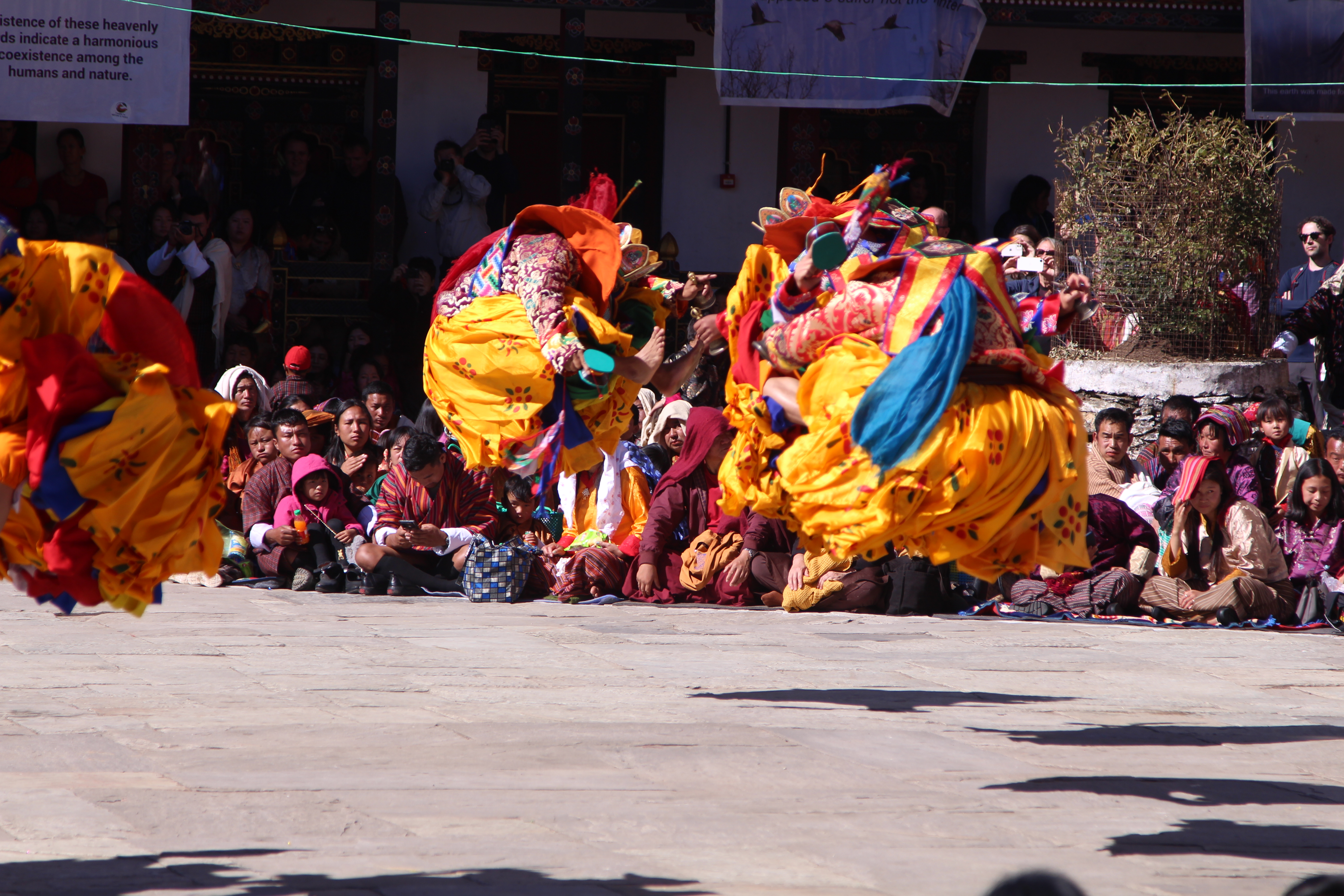
Tody we experience this colourful annual festival featuring masked dances, music and community celebrations. Taking place at the Tashigang Dzong and known for its unique cultural flair, drawing nomadic people from Merak and Sakten in their distinct attire. Tshechus are significant Bhutanese religious festivals featuring spiritual mask dances, blessings, and community gatherings, celebrating Guru Rinpoche and the triumph of good over evil, with these specific dates offering a chance to experience Eastern Bhutan’s vibrant traditions (B,L,D)
Day 7 Drive to Mongar
We return to the Tsechu this morning to witness the final day of the festival. After lunch we drive to Mongar (4 hours) known as the ‘Gateway to Eastern Bhutan’. The road descend to Kurichhu (river) cross kurichhu and meet Sherichhu. The road than ascend through Yadi village and Yadi Zig Zag. After Yadi village the road is built through broadleaf forest to Korela pass. After Korela pass, its 18 kms drive to Mongar. visit Mongar Dzong built in 1956. We overnight at a centrally based hotel (B,L,D)
Day 8 Drive to Bumthang
An early departure to Bumthang today. The journey from Mongar to Bumthang is a stunning, winding 7-8 hour drive (approx. 198km) through Bhutan’s eastern Himalayas, crossing the high Thrumshing La Pass (3750m), featuring dramatic valleys like Kuri Chuu. The drive from Mongar to Bumthang is one of the most beautiful drive in Bhutan. The road built through broad leaf conifer to broad leaf sub tropical forest. The road descend to Kuri chhu and soon ascend from Limithnag to Sangor. Keep eying for many wildlife, caped languor, Himalayan Thar, rare and endangered Red Panda and many more depending on luck. Lots of big waterfall to be seen. Lunch at Sangor. After lunch it take less than two hour to get to Thrimshing La pass ( alt 3400m) the pass divide east and central Bhutan. On a clear day, the eastern Himalayan peak of Bhutan can be seen from here. The road descend through droft Rhododendrons, Fir, cheer pine and blue spruce forest to Ura valley and continue the drive through Ura Shelthong La pass (alt 3680m) to Jakar, Bumthang (B,L,D)
We arrive to Bumthang in the late afternoon, and is the general name given to combination of four valleys – Chumey, Choekhor, Tang and Ura with altitude varying from 2,600m to 4,000m. It is home to many of prominent Buddhist temples and monasteries. Two nights at the Mountain View Resort with dinner (B,L,D)
Day 9 In Bumthang
This morning we visit Kurje Lhakhang, where the saint Padmasambhava subdued a local demon and left his body imprint on a rock., the Jambey Lhakhang (7th century temple), Tamshing Lhakhang (housing some of the oldest wall paintings in Bhutan) and Jakar Dzong (administrative centre of the region)
This afternoon we have short hike to Lhodrak Kharchhu Monastery founded by Namkhai Nyingpo Rinpoche in 1984 and has become part of an extensive effort to preserve and revitalize Tibetan culture. The monks regular curriculum include reading, memorizing the daily prayers, learning dharma dances, drawing mandalas, learning the melodies of sacred rituals, learning the use of ceremonial instruments and the art of making sacrificial objects, along with the basics of contemplation and instruction on the different stages of tantra.(B,L,D)
Day 10 Drive from Bumthang to Trongsa
We stop at Chumey, a wide fertile valley where wheat, barley, potatoes and buckwheat are cultivated. It is particularly know for its famous wool weaving called “Bumthang Yathra”. Later we drive (2.5 hours) to Trongsa crossing Yutong-la pass (3,400m/ 11,155 ft). The road climbs steeply through coniferous forest into a wide, open cultivated valley known as the Chumey valley. Finally the road winds down the pass to Trongsa. On arrival we visit Trongsa Dzong, built in 1648 it was the seat of power over central and eastern Bhutan and Ta Dzong, recently opened fort in Trongsa. The Ta Dzong, a cylindrical stone structure rising five stories, was built in 1652 by ChogyalMinjur Tempa. with eyes painted at four cardinal points. Overnight Tendrel Resort with dinner (B,L,D)
Day 11 Drive from Trongsa to Punahka
In the morning we cross Pelela pass (3,300 m), the traditional boundary between east and west. The passis marked by a large prayer flag and the ground is covered with high altitude dwarf bamboo. Stop en route at Chendbji Chorten, which was built in 18th century by a Lama named Shida, it is Nepalese in style. On arrival at Punakha we check-in to our hotel located right on the bank of the river. Two nights in the Zimkham Resort with dinner (B,L,D)
Day 12 In Punakha
After breakfast we hike to Khamsum Yuelay Namgyal Choeten, a moderate half hour hike through the rice paddies. Next we visit Punakha Dzong, a fortress built by Zhabdrung Ngawang Namgyal in 1637. Punakha served as the capital of Bhutan until 1955 and it still is the winter residence of the Central Monk Body. Later enjoy a picnic lunch on the banks of the Punak Chhu in the stunning dzong which straddles the confluence of the Mo Chhu (Mother River) and Pho Chhu (Father River). After lunch we drive to the village of Talo for a walk in the beautiful and quiet grounds of the village temple and visit the home village of the Kingdom’s four Queens (B,L,D)
Day 13 Drive Punakha to Thimpu. Visit Thimphu
Our drive (3 hours) this morning is via the Dochula Pass (3100m). The pass is marked by a large massive choeten, 108 smaller choetens (Druk Wangyel Choetens) and prayer flags. The pass offers the most spectacular view over the high peaks of the eastern Himalayas. We arrive at Thimphu the capital town of Bhutan and the centre of government, religion and commerce, Thimphu is a unique city with a mixture of modern development alongside ancient traditions. On arrival in Thimphu we check-in to our hotel. After lunch we We visit the National Library, which holds a vast collection of ancient Buddhist texts and manuscripts, some dating back several hundred years and the Textile and Folk Heritage Museum – these museums, both of which opened in 2001, provide fascinating insights into Bhutanese material culture and way of life. Two nights at the Kisa Hotel with dinner (B,L,D)
Day 14 In Thimpu
This morning we visit the National Memorial Chorten. The building of this landmark was envisaged by the third king, His Majesty Jigme Dorji Wangchuck, as a monument to world peace and prosperity. Completed in 1974 after his untimely death, it is both a memorial to the Late King (“the Father of modern Bhutan”) and a monument to world peace. The paintings and statues inside the monument provide a deep insight into Buddhist philosophy. The afternoon is left free to explore the town perhaps to shop at some of the excellent souvenir market stalls (B,L,D)
Day 15 Drive to Paro. Visit ‘Tigers Nest’
Early breakfast and drive to Paro to visit Taktshang Monastery (5hrs hike) known as Tiger’s Nest, the most famous of Bhutan’s monasteries, perched on the side of a cliff 900m above the Paro valley floor. It is said that Guru Rinpoche arrived here on the back of a tigress and meditated at this monastery and hence it is called ‘Tiger’s Nest’. On the way back we visit Drukgyel Dzong built in 1646 by Shabdrung Ngawang Namgyal to commemorate his victory over the Tibetan invaders and Kyichu Lakhang one of the oldest shrines of the Kingdom dating back to the 7th century (B,L,D). Overnight at Khangkhu Resort with dinner (B,L,D)
Day 16 Fly Paro – Kathmandu
Early morning transfer to the airport for our flight to Kathmandu. Tour ends (B)
£4,995.00 pp based on sharing a twin room
£495.00 Single Supplement
Price includes
Tour escorted from Kathmadu by Patrick Syder FRGS
Specialist Bhutanese cultural guide for the duration of the tour
All transportation by a/c bus
Return flights from Kathmandu to Paro with Druk Air
One way internal flight from Paro to Bumthang with Druk Air
Full sightseeing programme including entrance fees
Comfortable three star standard category tourist hotels
Kathmandu transit hotel on B+B basis with airport transfers
All meals in hotel or local restaurants
Bottled water daily
Porter, hotel and restaurant staff gratuities
Royalty and Tourism Development Fund Taxes
Please note tour involves some long drives and reasonably high altitudes
PLEASE NOTE – personal travel insurance, visa fees, alcoholic drinks, guide and driver gratuities, international flights to Kathmandu are not included in the land tour cost
 Syder Travel
Excellent news! I confirm that I will be travelling